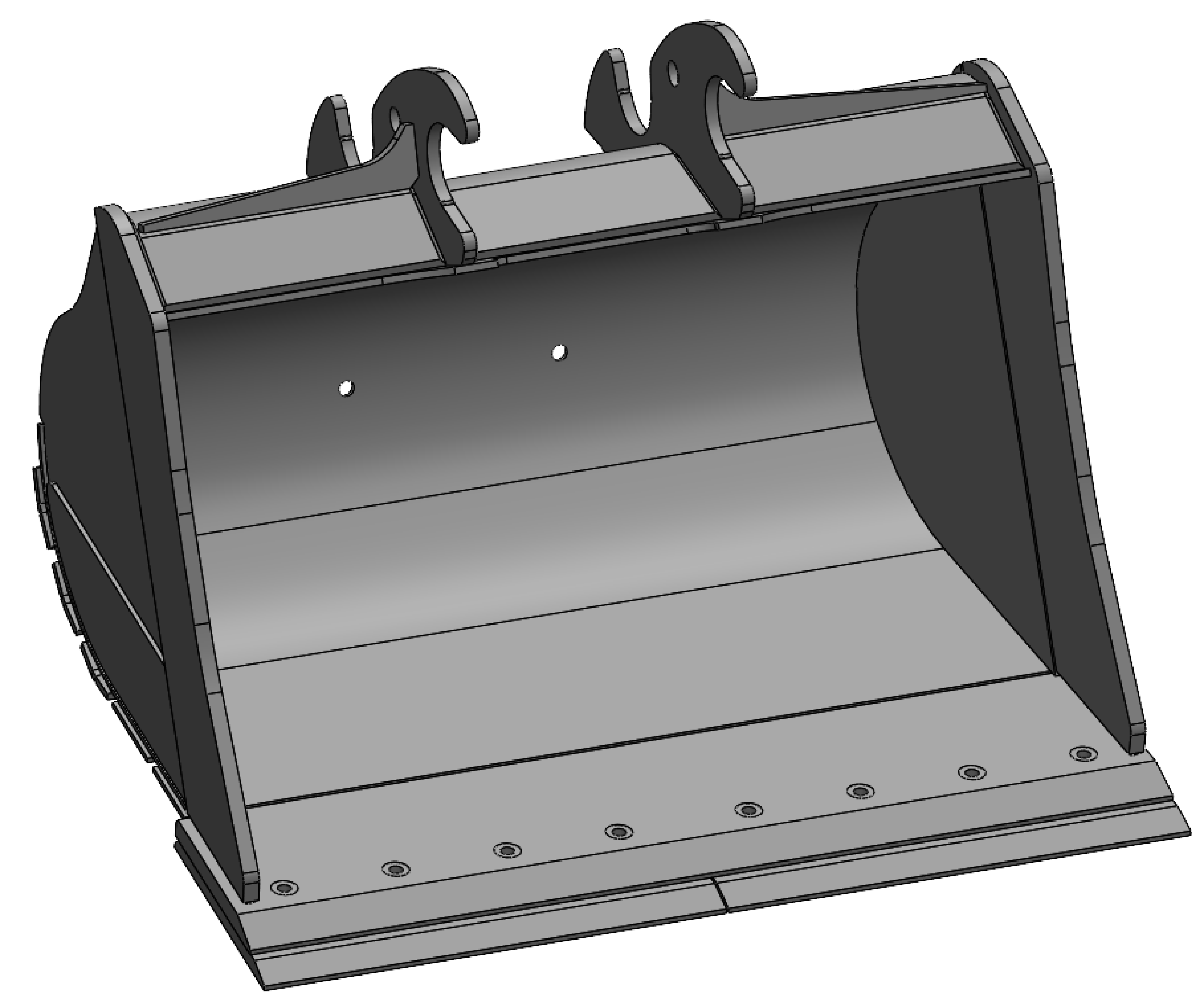
The high-strength bucket is not just an ordinary bucket that can be made stronger by adding thick steel plates. It is fundamentally different. So, what exactly makes it different?
1.The steel plates are thicker. The smallest one starts at 12mm, and the largest can reach up to 30mm.
2.There is no omission in the areas that need reinforcement. Double-layer bottom plates, side plates with wear-resistant layers, and reinforcing corners - none are missing.
3.The bucket teeth and tooth seats are capable of withstanding impacts. They are not the kind that fall off after just two days of use.
4.The ear pins and bushings are made more solid, able to withstand great forces.
In short, if you are doing tasks like digging stones, demolishing buildings, or doing hard work, you need a high-strength bucket.
What should be mainly considered when choosing a bucket?
Plate thickness, this is the most direct factor
Don't just look at the appearance. First, feel how thick the steel plate is. For a genuine high-strength bucket, the thickness of the small machine should be at least 12mm, and for the large machine, it should be 20 to 30mm. If you feel the steel plate is too thin, then it's probably not reliable.
How to view strengthening the structure
Apart from the thickness of the steel plate, it is also necessary to check if there is a double bottom plate, as this is the most prone to wear. Then, look at whether there are reinforcing ribs on the side, and whether the hinged area is sturdy. Many cheap buckets have problems with the hinged area first.
The bucket teeth also need to be taken into consideration
The bucket teeth should be matched to your specific working conditions. If you are digging stones, I recommend using double-wing bucket teeth as they have better penetration ability. Also, don't forget the guard teeth. Don't skimp on it; that thing can protect the blade plate, saving you from constantly replacing it.
Divide into simple categories: standard type, high-strength type, and super heavy type.
Let me briefly explain it so that you can compare it easily.
Standard type, with steel plates ranging from 6 to 10mm, suitable for digging soil, sand and light gravel. Usually used on machines with a capacity of 5 to 25 tons.
High-strength type, with steel plates ranging from 12 to 20mm, suitable for mixed rocks, demolition, hard clay, and can be used with machines weighing 20 to 50 tons.
Super heavy-duty, with steel plates ranging from 20 to 30mm. This is for heavy-duty tasks such as blasting rocks, quarrying, and mining. Generally, excavators with a capacity of 40 to 100 tons are the ones that can use it.
When is it necessary to use the high-intensity bucket?
To be honest, in the following situations, don't hesitate and go straight for the high-intensity or rock bucket:
Quarrying and mining for stone
Demolishing buildings and concrete, where there are many steel bars
Digging trenches and channels on hard stone surfaces
Loading in materials like slag and crushed stones that are troublesome to handle
Large-scale earthwork projects, involving large quantities and heavy loads
If your construction site is exposed to these, don't try to buy standard types at a low price. Saving that little money won't be enough to buy the machinery.
What can Guo Run offer you?
At Guo Run, our high-strength buckets cover all the major brands, including CAT, Komatsu, Hitachi, Volvo, and Kobelco. We have everything you need.
Our bucket has several features:
The worn-out areas are covered with Hardox 400 or 450 wear-resistant plates, made of genuine materials.
The distance between the pins is the same as the original model, and there's no need to make any adjustments when installing.
The configuration of the bucket teeth can be customized according to your specific needs.
The welding process is certified by ISO 9001 and is not done carelessly.
We also sell bucket attachments pre-installed with bucket teeth. Just take them back and install them directly, it's very convenient.
The last few suggestions
First, don't go for the oversized option. The bucket size should be compatible with your machine. Overloading it will not only reduce efficiency but also damage the machine.
Second, it depends on what you are digging. The heavier the material, the smaller the bucket capacity needs to be. This is a simple principle.
Thirdly, the heavier-duty bucket will have a slightly higher fuel consumption, but it is more durable. It's up to you to decide which option is better.
Finally, find a reliable manufacturer. At Guo Run, we are responsible for every bucket we produce. If there are any issues, we will take care of them until they are resolved.
Want to buy a high-strength excavator bucket? Just contact Guo Run. We will help you choose the size and configuration, without misleading you, and only offer genuine suggestions.